

Blogs
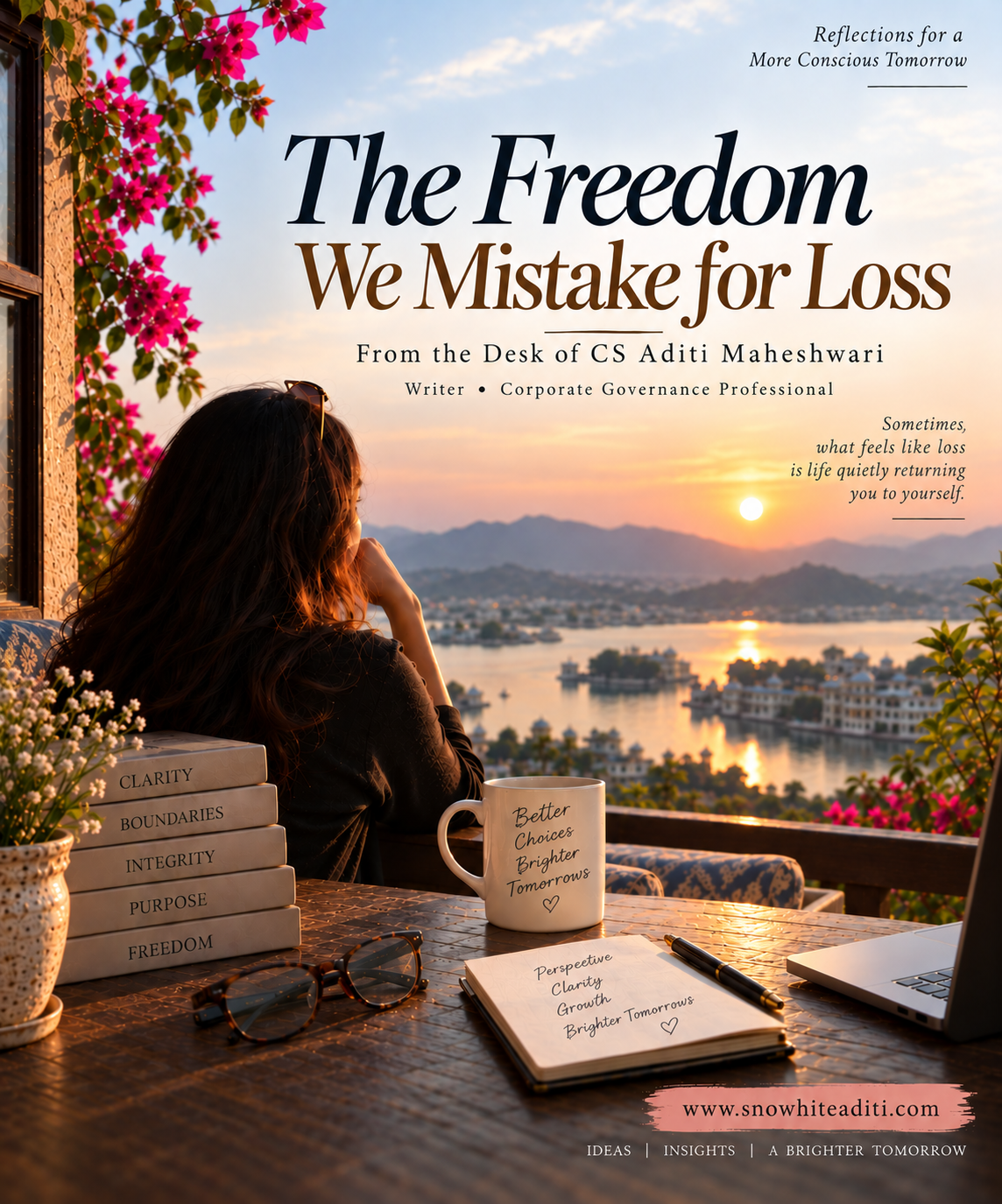
The Freedom We Mistake for Loss
We rarely notice the moment when endurance quietly turns into self-abandonment. Love is visible. It does not need to be forced, reminded of, explained away, or endlessly postponed. Sometimes it appears in what someone does; sometimes in what they repeatedly choose not to do. Actions reveal something. Inaction does too. The same is true of how we treat ourselves. Self-love is visible in the choices we make and the boundaries we hold.
Recognising this is not being judgemental. Nor does it require defending an absence of love with elaborate ideas about “unconditional love”, circumstances, compulsions, or sacrifice. Sometimes the deeper truth is much simpler and much harder: to accept what is, live with that acceptance, and make different choices moving forward. Perhaps the question worth asking is: when does acceptance become an act of integrity, and when does endurance become a way of abandoning oneself?
What initially feels like a setback can, with time, reveal itself as freedom.
The difficulty is that freedom rarely arrives looking like freedom. In the beginning, it may look like loss. It may hurt so deeply that acceptance feels almost impossible. But pain changes shape. Gradually, we acquire the strength to live with what we could not change. And perhaps, one day, we realise that we did not lose ourselves in the process of losing something else.
We are not what happened to us. We are what we choose to do with what happened to us.
That distinction matters.
Can one live indefinitely in a life that makes the self feel empty? Can constantly surrendering to circumstances really be called freedom? The deeper truth is rarely convenient. Yet inconvenience does not make truth less worthy of consideration. Perhaps what we call losing is sometimes simply moving towards freedom.
Why live permanently inside anxiety, fear, uncertainty or emotional depletion when a life built around dignity, integrity, and purpose is possible? The self is not an object permanently open for negotiation. Self-respect is not a luxury to be surrendered whenever love demands it. It is a boundary.
And self-love does not mean believing oneself superior to another person. It means treating oneself with the same dignity, consideration, and humanity that one believes another deserves. Nothing should require the destruction of that dignity.
There is also a persistent misconception that love is synonymous with sacrifice. It is not. Love may require compromise, patience, generosity, and courage. But love should not require the systematic sacrifice of one's identity, dignity, or self-respect.
Perhaps we also need to become more cautious about how quickly we judge other people. We often believe we know someone's story because we have witnessed one moment of it. We construct explanations from prima facie evidence, while the deeper story may be entirely different.
I once witnessed a Class II student who had lost both his parents in an accident. When he returned to school just three days later, he was trying to act strong. The tears had not fallen, but they were unmistakably visible in his eyes.
It was deeply uncomfortable to witness.
But it taught me something I have never forgotten: life can sometimes be unimaginably cruel, and there are moments when there is nothing to repair, reverse or explain. There is only acceptance. Not passive acceptance, but the painful acceptance of reality, followed by the decision to keep moving with whatever strength remains.
Perhaps, eventually, we outgrow some of our pain. Not because it never mattered, but because life became larger than the incident that caused it.
Life is not fair, and expecting it to be fair can sometimes become another form of suffering. What we can examine, however, are our own choices. We can ask whether we are living with integrity. Whether we are giving others what we reasonably can. Whether our generosity has boundaries. Whether our kindness is leaving enough strength for us to remain whole.
Because always being there for everyone can sometimes mean becoming absent from your own life.
Healthy boundaries are not evidence of diminished love. They are evidence that the self has finally been included in the definition of love.
Perhaps we should therefore reconsider the familiar question: why cross oceans for someone who would not cross a puddle for you?
It sounds harsh because it is deliberately simple. But perhaps the more important question is not whether someone would cross an ocean for us. It is whether we have become so accustomed to crossing oceans that we no longer notice that we are drowning.
People do not always know what they have been given. They do not always understand what someone silently carried for them. They may never fully comprehend the cost of another person's patience, presence, or sacrifice. And that is precisely why our lives cannot be built around being understood by everyone.
At some point, acceptance has to replace explanation. Boundaries have to replace resentment. Self-respect has to replace self-abandonment. And freedom has to become more important than the desperate need to make someone recognise our worth.
Perhaps grace is not always about what stays. Sometimes grace is recognising what has ended, refusing to turn bitter because of it, and walking forward without abandoning the person we are becoming.
That may hurt. It may hurt for a very long time. But there is a quiet strength in discovering that the life ahead does not have to remain hostage to what happened behind us.
We cannot choose everything that happens to us. But we can choose what happens next.
Remember, acceptance is not surrender. It is something much deeper: the willingness to see reality without constantly negotiating with it. Every life carries a story we know nothing about, which is reason enough to be gentler in our judgements and easier to deal with. Life already presents enough challenges; there is little wisdom in becoming another challenge in someone else’s life.
Our behaviour is revealed not only through our words and actions, but also through our inactions, our silences and the things we repeatedly choose not to do. Perhaps we are good people who have made mistakes along the way. But what truly holds us back from acknowledging them, taking ownership and attempting to repair what we can? Stubbornness is not a shield against vulnerability; often, it exposes the very vulnerability it is trying to conceal. Humility is not merely accepting compliments with grace. It is also having the courage to handle our mistakes with grace. If we know that something we did or did not do caused pain, why should acknowledging it and making an honest effort to correct it diminish us?
Perhaps this brings us back to the simplest truth: what matters is visible. And if there is one thing worth remembering, it is that the deepest form of regard is respect. In the end, the choice is not between being right and being wrong, nor between staying and leaving. It is between personal accountability and personal escape.